
You hired a new provider three months ago. She’s seeing patients. Generating revenue. Except she’s not generating revenue. Not really. Because her credentialing applications are still sitting somewhere in payer limbo. Every claim for every patient she sees gets denied. You’re eating the cost or scrambling to bill under another provider. Either way, you’re losing thousands daily.
This isn’t unusual. This is normal for practices managing provider credentialing internally.
The average credentialing timeline should be 60-90 days. But most practices experience 120-180 days or longer. Some applications sit for a year. During that time, your provider works for free. Your practice bleeds money. Your patients get frustrated with billing confusion.
Let me show you exactly why credentialing backlogs happen, and how credentialing services eliminate them completely.

In This Blog
- The Application Mistakes That Reset Your Timeline …………………………………………………………. 1
- The Follow-Up That Never Happens …………………………………………………………. 2
- The CAQH Profile Problems That Stall Everything …………………………………………………………. 3
- The Multi-Payer Chaos That Overwhelms Internal Teams …………………………………………………………. 4
- The Payer Priority Mistakes That Cost You …………………………………………………………. 5
- When Your Existing Credentials Expire Without Warning …………………………………………………………. 6
- The Recredentialing Timeline Nobody Plans For …………………………………………………………. 7
- The Specialty-Specific Credentialing Complexity …………………………………………………………. 8
- Calculating Your Real Cost Per Day of Delay …………………………………………………………. 9
- The Hidden Costs Beyond Lost Revenue …………………………………………………………. 10
- How Professional Credentialing Services Eliminate Backlogs …………………………………………………………. 12
- Stop Losing Revenue to Credentialing Delays …………………………………………………………. 13
The Application Mistakes That Reset Your Timeline
Incomplete Information That Triggers Automatic Rejections
Your office manager submits a provider credentialing application. She thinks everything is complete. The payer receives it, runs their initial review, and sends it back. Missing information. Missing documents. Missing signatures. The application goes to the bottom of the queue. You just lost 30-45 days.
Common application errors that cause delays:
| Error Type | Frequency | Average Delay Added |
|---|---|---|
| Missing professional references | 35% of applications | 30-45 days |
| Incomplete work history gaps | 28% of applications | 45-60 days |
| Missing or expired documents | 42% of applications | 30-60 days |
| Incorrect NPI information | 18% of applications | 15-30 days |
| Missing malpractice coverage details | 25% of applications | 30-45 days |
| Unsigned or incorrectly dated forms | 31% of applications | 20-30 days |
One mistake doesn’t just add delay. It resets your entire timeline. The application goes back to square one. Your 90-day process becomes 150 days. Your provider continues working without getting paid.
Professional credentialing services catch these errors before submission. They verify every field. Cross-check every document. Ensure every signature is present. Applications go in clean. They stay in process. Your timeline stays on track.
The Document Expiration Trap
You finally get your application complete. You submit it. Three months later, the payer is ready to approve. But now your provider’s malpractice certificate has expired. The application stops. You need updated documentation. You resubmit. Another 30-60 days added.
Documents that expire during credentialing:
| Document Type | Typical Validity | Risk of Expiration During Process |
|---|---|---|
| Malpractice insurance certificate | Annual | High (40% of applications) |
| State medical license | 1-2 years | Medium (15% of applications) |
| DEA certificate | 3 years | Low (5% of applications) |
| Board certification | 10 years | Very Low (2% of applications) |
| CPR/BLS certification | 2 years | Medium (20% of applications) |
Medical credentialing services track expiration dates proactively. They submit renewal documents before expiration. They prevent the expiration trap entirely. Your application keeps moving forward.
The Follow-Up That Never Happens
Why Applications Sit Untouched for Months
Payers receive hundreds of insurance credentialing applications monthly. Yours is one of many. It sits in a queue. Nobody is actively working on it unless someone pushes it forward. Your internal team submits and hopes. They don’t follow up because they don’t know who to call or when to call.
Typical payer processing timeline without follow-up:
| Processing Stage | Standard Duration | Duration Without Follow-Up |
|---|---|---|
| Initial receipt and logging | 3-5 days | 10-15 days |
| Completeness review | 7-10 days | 20-30 days |
| Primary source verification | 30-45 days | 60-90 days |
| Committee review | 14-21 days | 30-60 days |
| Final approval and setup | 7-10 days | 15-30 days |
| TOTAL | 61-91 days | 135-225 days |
The difference between 90 days and 180 days? Follow-up. Persistent, strategic follow-up that moves your application through the queue faster.
Credentialing companies employ specialists who do nothing but follow up with payers. They know the right people to call. They know the right questions to ask. They know when to escalate. They turn 180-day timelines into 75-day timelines through sheer persistence.
The Payer-Specific Contacts Nobody Knows
Each payer has different credentialing departments. Different phone numbers. Different contact people. Different escalation procedures. Your internal team calls the general provider services line. They get transferred three times. They leave a message. Nobody calls back.
Professional provider credentialing services maintain databases of direct contacts at every major payer. They bypass general lines. They reach decision-makers directly. They get answers immediately.
Impact of direct payer contracts:
| Contact Method | Average Response Time | Issue Resolution Rate |
|---|---|---|
| General provider line | 5-7 days | 35% |
| Credentialing department main line | 3-5 days | 55% |
| Direct credentialing specialist contact | Same day to 24 hours | 85% |
| Escalation to supervisor/manager | 1-2 days | 95% |
Access to the right contacts cuts your timeline by 30-50%. Professional services have these contacts. You don’t.
The CAQH Profile Problems That Stall Everything
When Your CAQH Data Doesn’t Match Applications
Most payers use CAQH for provider enrolment and credentialing. Your CAQH profile needs to match your individual payer applications exactly. If there’s a discrepancy, the application stops. The payer requests clarification. You’re delayed another 2-4 weeks while you fix it.
Common CAQH discrepancies that halt credentialing:
| Discrepancy Type | Occurrence Rate | Average Delay |
|---|---|---|
| Address mismatch | 28% | 14-21 days |
| Name variations | 22% | 14-28 days |
| Work history gaps or differences | 31% | 21-45 days |
| Education information mismatch | 15% | 14-21 days |
| Hospital affiliation differences | 19% | 21-30 days |
| Board certification status mismatch | 12% | 14-28 days |
Your internal team doesn’t think to cross-check CAQH against individual applications. They submit both independently. Discrepancies emerge during payer review. Everything stops.
Medical credentialing services audit CAQH profiles before submitting applications. They ensure perfect alignment. They prevent discrepancy delays before they happen.
The CAQH Attestation That Expires Mid-Process
CAQH requires quarterly attestation. Your profile was current when you started credentialing. Three months later, it’s expired. The payer can’t pull your data. Your application stalls until you re-attest. Another 2-3 weeks lost.
CAQH attestation timeline risks:
| Time to Credentialing Completion | Risk of Expiration | Typical Impact |
|---|---|---|
| 60 days | Low (10%) | Minimal |
| 90 days | Medium (35%) | 14-21 day delay |
| 120 days | High (65%) | 21-30 day delay |
| 150+ days | Very High (85%) | 30-45 day delay |
Professional credentialing services monitor CAQH attestation dates religiously. They re-attest proactively before expiration. Your profile stays active throughout the entire credentialing process.
The Multi-Payer Chaos That Overwhelms Internal Teams
Trying to Track Multiple Applications Simultaneously
You’re credentialing your new provider with six different payers. Each has a different process. Different timelines. Different requirements. Different contact people. Your office manager is tracking all six manually in a spreadsheet. Things slip through cracks.
Complexity of managing multiple simultaneous credentialing applications:
| Number of Applications | Internal Management Success Rate | Average Time to Complete All |
|---|---|---|
| 1-2 payers | 85% | 90-120 days |
| 3-4 payers | 65% | 120-150 days |
| 5-7 payers | 45% | 150-210 days |
| 8+ payers | 25% | 180-270 days |
The more payers you’re dealing with, the more opportunities for mistakes. The more follow-ups required. The more documents to track. Internal teams get overwhelmed quickly.
Provider credentialing services use specialized software to track every application, every deadline, every follow-up. Nothing falls through cracks. All applications progress simultaneously without confusion.
The Payer Priority Mistakes That Cost You
Not all payers are equal. Some represent 30% of your patient volume. Others represent 2%. Your internal team treats all applications equally. They don’t prioritize based on revenue impact. Your highest-volume payer applications sit while low-volume applications get attention.
Strategic payer prioritization by revenue impact:
| Payer Type | % of Patient Volume | Priority Level | Target Completion |
|---|---|---|---|
| Top 3 commercial payers | 40-50% | Critical | 60-75 days |
| Medicare | 25-35% | Critical | 45-60 days |
| Medicaid | 10-20% | High | 75-90 days |
| Secondary commercial payers | 8-15% | Medium | 90-120 days |
| Low-volume payers | 2-5% | Low | 120-150 days |
Professional services prioritize strategically. Your highest-revenue payers get completed first. You start collecting from your biggest patient populations immediately. Lower-volume payers follow systematically.
When Your Existing Credentials Expire Without Warning
Your provider has been credentialed for three years. Her credentials expire in 60 days. Nobody knows. Nobody’s tracking it. Claims suddenly start denying. You realize her credentials lapsed. Now you’re emergency recredentialing while losing revenue daily.
Cost of credential expiration:
| Impact Area | Average Cost/Loss |
|---|---|
| Claims denied during lapse | $35,000-$75,000 |
| Emergency processing fees | $500-$2,000 per payer |
| Lost patient volume (patients go elsewhere) | $15,000-$40,000 |
| Staff time fixing the problem | $5,000-$10,000 |
| TOTAL COST PER LAPSE | $55,500-$127,000 |
This happens constantly in practices managing credentialing internally. Nobody has a systematic tracking process. Expirations sneak up. Revenue stops flowing. Panic ensues.
Credentialing services for providers track every expiration date for every payer for every provider. Recredentialing applications go out 90-120 days before expiration. You never lose credentials. Claims never stop paying.
The Recredentialing Timeline Nobody Plans For
Recredentialing isn’t instant. It takes 60-90 days just like initial credentialing. If you wait until credentials expire to start recredentialing, you’re already 60-90 days too late. Your provider will be uncredentialed for months.
Recredentialing timeline best practices:
| Action | Recommended Timing | What Happens If Delayed |
|---|---|---|
| Begin tracking | 120 days before expiration | Miss the window entirely |
| Submit applications | 90 days before expiration | Risk of credential lapse |
| Follow up with payers | 60 days before expiration | Guaranteed gaps in coverage |
| Confirm completion | 30 days before expiration | Too late to fix problems |
Internal teams don’t plan this far ahead. They’re reactive, not proactive. Professional provider credentialing services operate on proactive timelines. Your credentials renew seamlessly without gaps.
The Specialty-Specific Credentialing Complexity
If you’re a therapist or mental health provider, insurance credentialing for therapists is uniquely complicated. Additional requirements include:
Mental health credentialing requirements:
| Requirement | Standard Medical | Mental Health | Additional Complexity |
|---|---|---|---|
| Professional liability minimums | $1M/$3M | $2M/$4M often required | Higher cost, harder to obtain |
| State licensure types | Standard MD/DO | LCSW, LPC, LMFT, PsyD, etc. | Payer acceptance varies widely |
| Supervision documentation | Not required | Required for associates | Complex documentation needs |
| CAQH participation | Standard | Limited for some license types | Manual processes required |
| Practice specialty codes | Straightforward | Multiple subspecialties | Confusion about correct codes |
Mental health credentialing services understand these unique requirements. They know which payers accept which license types. They handle associate supervision documentation correctly. They navigate the complexity that trips up general credentialing staff.
Dental Credentialing and Its Unique Pathways
Dental insurance credentialing follows completely different processes than medical credentialing. Most medical credentialing staff don’t understand dental-specific requirements:
Dental vs medical credentialing differences:
| Credentialing Element | Medical Credentialing | Dental Credentialing |
|---|---|---|
| Primary database | CAQH | Limited CAQH use, often direct applications |
| License verification | State medical board | State dental board plus specialty certifications |
| DEA requirement | Often required | Rarely required |
| Hospital privileges | Commonly required | Rarely applicable |
| Procedure code systems | CPT codes | CDT codes |
| Primary verification source | NPDB, state boards | Different verification entities |
If you run a dental practice using general medical credentialing services, you’ll face constant delays. You need specialists who understand dental billing and dental insurance verification requirements. The processes don’t translate directly.
Calculating Your Real Cost Per Day of Delay
Every day your provider isn’t credentialed is a day of lost revenue. Let’s calculate the real cost.
Daily revenue loss calculation:
| Provider Type | Avg Patients/Day | Avg Revenue/Patient | Daily Loss | Monthly Loss | 90-Day Delay Cost |
|---|---|---|---|---|---|
| Primary Care | 18 | $185 | $3,330 | $66,600 | $199,800 |
| Specialist | 12 | $425 | $5,100 | $102,000 | $306,000 |
| Therapist | 8 | $160 | $1,280 | $25,600 | $76,800 |
| Dentist | 10 | $385 | $3,850 | $77,000 | $231,000 |
| Surgeon | 6 | $2,800 | $16,800 | $336,000 | $1,008,000 |
Every week of delay costs you thousands to tens of thousands. Every month compounds the loss. A 90-day credentialing delay that becomes 180 days due to internal mismanagement? You just doubled your revenue loss.
The Hidden Costs Beyond Lost Revenue
The direct revenue loss is only part of the picture. Credentialing delays create additional hidden costs:
Hidden costs of credentialing delays:
| Cost Category | Typical Impact | Annual Cost |
|---|---|---|
| Staff time managing credentialing | 15-20 hrs/week @ $35/hr | $27,300-$36,400 |
| Provider frustration/turnover risk | 1 provider leaves early | $75,000-$150,000 |
| Emergency credentialing fees | Rush processing when desperate | $3,000-$8,000 |
| Billing under other providers (compliance risk) | Audit penalties if caught | $10,000-$50,000 |
| Lost patient relationships | Patients switch providers permanently | $25,000-$75,000 |
| TOTAL HIDDEN COSTS | $140,300 to $319,400 | |
You’re not just losing the revenue your provider would generate. You’re paying massive hidden costs trying to manage the credentialing process internally.
How Professional Credentialing Services Eliminate Backlogs
When you partner with expert credentialing services, the entire process transforms:
Credentialing timeline comparison:
| Process Stage | Internal Management | Professional Services | Time Saved |
|---|---|---|---|
| Application preparation | 2-3 weeks | 3-5 days | 10-16 days |
| Submission and initial review | 2-4 weeks | 5-7 days | 9-21 days |
| Follow-up and status checks | 4-8 weeks | 2-3 weeks | 14-35 days |
| Issue resolution | 3-6 weeks | 1-2 weeks | 14-28 days |
| Final approval to claims acceptance | 2-3 weeks | 1 week | 7-14 days |
| TOTAL TIMELINE | 13-24 weeks | 6-9 weeks | 54-114 days |
Professional services cut your timeline by 50-60%. That’s 2-4 months of revenue you capture instead of lose.
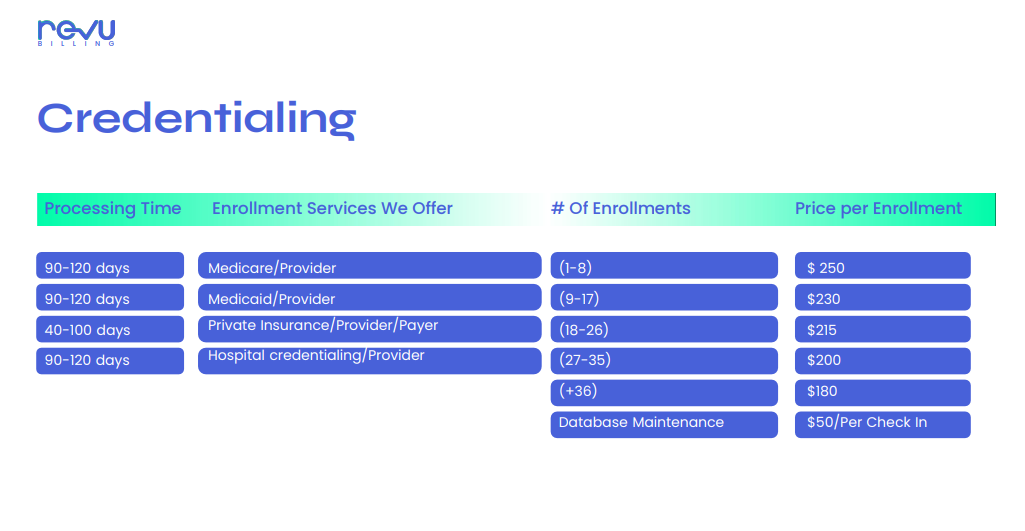
What professional credentialing services provide:
- Complete application management – Every field filled correctly, every document included, every signature obtained
- Proactive document tracking – Expiration dates monitored, renewals submitted early, no mid-process delays
- Persistent payer follow-up – Weekly status checks, direct contact access, escalation when needed
- CAQH profile optimization – Perfect alignment with applications, proactive attestation, zero discrepancies
- Multi-payer coordination – All applications tracked simultaneously, strategic prioritization, nothing falls through
- Recredentialing automation – Expiration tracking 120+ days out, applications submitted proactively, zero lapses
- Specialty-specific expertise – Mental health, dental, surgical specialties handled correctly
- Real-time status visibility – Portal access showing exactly where every application stands
Stop Losing Revenue to Credentialing Delays
Your competitors who use professional provider enrolment and credentialing services? Their new providers start generating revenue 2-3 months before yours do. They’re not smarter. They just made a better decision about where to invest their time and money.
Ready to stop losing revenue to credentialing delays? RevuBilling provides credentialing services that get your providers enrolled and collect revenue in 6-10 weeks, not 4-6 months. Our specialists handle insurance credentialing for providers, mental health credentialing, dental credentialing, and all specialty-specific requirements with zero delays.
We manage CAQH profiles, track every deadline, follow up persistently with every payer, and ensure your providers never lose credentials due to expiration. Calculate exactly how much revenue you’re losing to credentialing backlogs using our cost calculator at RevuBilling. Stop waiting months to collect. Start generating revenue in weeks.